
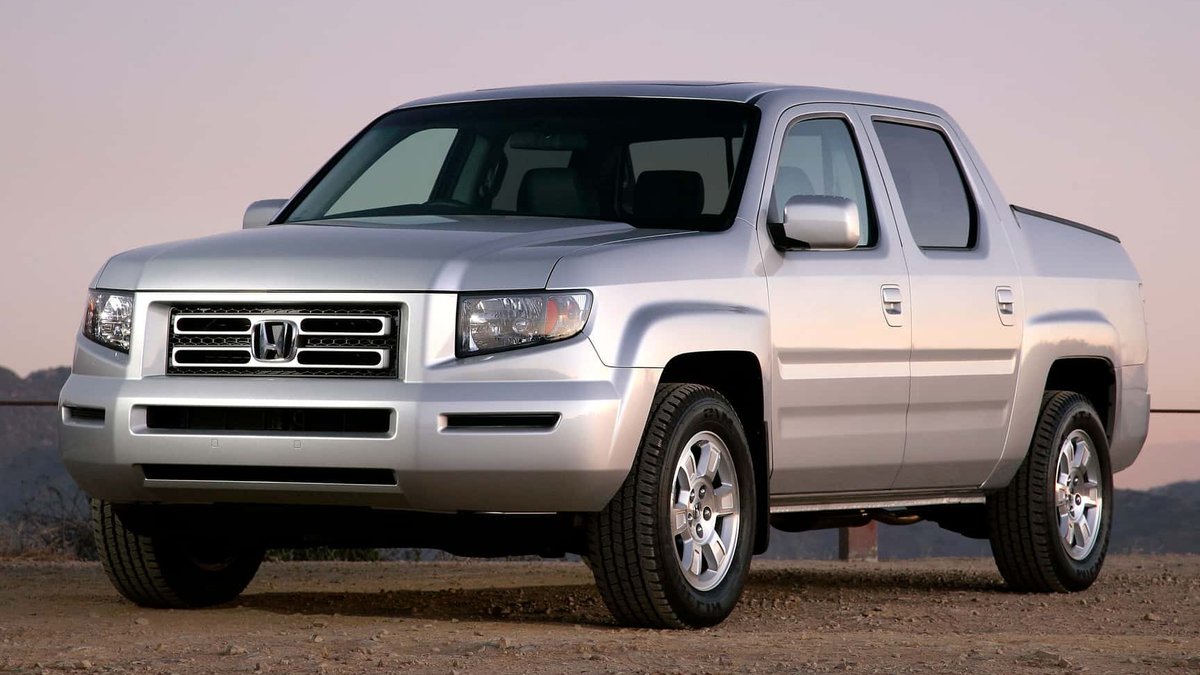
Honda’s Ridgeline pickup truck has long faced criticism from traditional truck owners, who label it a “fake truck.” According to Don Herner, the retired exterior design lead, this perception stems from the Ridgeline’s unconventional origins, which began as a side project in the early 2000s without a formal assignment. This freedom allowed the team to explore unique ideas, ultimately shaping the Ridgeline’s distinct characteristics. The unibody pickup launched for the 2006 model year, with Honda intentionally setting out to create something different.
Herner revealed that the Ridgeline started as a personal sketch project within Honda’s studio, with no executive brief guiding its development. This unconventional start helps explain why the Ridgeline has faced “fake truck” jokes for two decades. Herner himself noted, “I do not want to call it a truck because it was not really designed to be a truck, but everybody thinks it is.”
A Vehicle with SUV-Like Space
Honda internally referred to the Ridgeline project as the “Advanced Capabilities Vehicle”, emphasizing its focus on SUV-like interior space rather than traditional truck capabilities. Herner highlighted the Ridgeline’s interior size, legroom, and couple distance, which surpassed competitors like the Tacoma at the time. This priority influenced the Ridgeline’s development, with Honda executives reportedly finalizing the interior packaging before the exterior design. The vehicle’s unibody construction, shared with the Odyssey minivan, further reflected its SUV-inspired approach. Notably, the Ridgeline was the largest production vehicle Honda had ever built at the time, requiring modifications to the assembly line to accommodate its size.
Honda even explored co-branding the Ridgeline with Nike’s All Condition Gear outdoor line, though this partnership never materialized. This reflects the company’s ambition to position the Ridgeline as a versatile, lifestyle-oriented vehicle rather than a traditional workhorse.
Engineering Constraints Shaped Design Choices
Herner’s team initially envisioned the Ridgeline with 32 to 35-inch wheels and tires, but Honda’s engineers overruled this decision. The company’s transmission limitations and the need to preserve torque led to smaller wheels, ensuring the 3.5-liter V6 engine‘s 255 horsepower and 252 pound-feet of torque could effectively reach the ground. Herner explained, “Honda does not make a transmission robust enough to turn gigantic wheels and tires.”
The Ridgeline‘s cargo bed also underwent compromises. Its steel-reinforced composite construction allowed for a maximum bed load of 1,100 pounds, which critics used to question the truck’s capabilities. However, Herner defended the bed’s robustness, citing computer-aided engineering tests that overloaded it without failure. Despite these compromises, the first-generation Ridgeline offered innovative features, including a dual-action tailgate, lockable underbed storage, and fold-up rear seats. These features, combined with a total payload rating of around 1,500 pounds and 5,000 pounds of towing capacity, met the needs of many midsize truck buyers.
Evolution and Future Plans
Honda has maintained the Ridgeline’s unibody construction and utility-focused features in subsequent generations, while updating its exterior design to align with traditional pickup styling cues. A third-generation Ridgeline is currently in development, scheduled to reach the market within two years. Production of the current Ridgeline will pause in 2026, making way for the new model.


Leave a Reply