
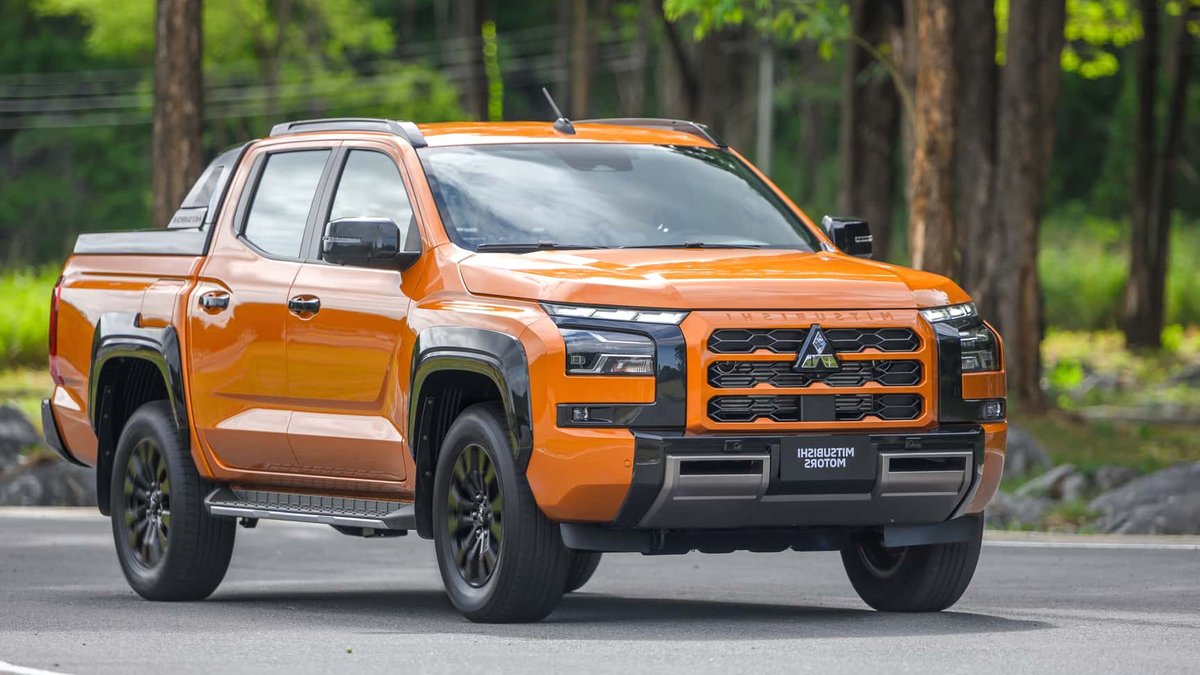
Honda is entering the pickup truck market for the first time, and the vehicle will not be a Honda creation. The Japanese automaker has confirmed a memorandum of understanding with Mitsubishi to develop a Honda-badged pickup truck based on the Triton, with sales planned to begin in 2028. The announcement follows weeks of speculation that Honda would adopt a badge-engineering strategy to quickly enter the segment.
Building on an Existing Platform
The new truck will likely be a simple rebadging of the Triton rather than a completely new design. The agreement marks the first complementary vehicle-supply initiative between the two companies. Mitsubishi will provide the hardware, and Honda will apply its name and branding to the model.
Developing a new body-on-frame truck from scratch would take considerable time and money. Borrowing Mitsubishi’s existing hardware makes far more sense for a 2028 launch. The base model will use the Triton’s ladder frame, a structure designed for durability, which is built to handle rugged roads and demanding work.
For the time being, Honda has stated that the new pickup truck will be developed using the Triton platform, a one-ton truck built on a robust ladder frame and marketed in certain regions as the L200. It remains uncertain whether the final product will be a straightforward rebadging of the existing model or incorporate unique design elements, but the company leans toward the simpler approach to minimize expenses and accelerate development timelines.
Powertrain and Capabilities
Under the hood, the truck will likely carry over Mitsubishi’s engine options. The lineup includes a 2.4-liter turbodiesel four-cylinder and a naturally aspirated 2.4-liter gas engine. Output varies by market and trim, with the range-topping twin-turbo diesel producing up to 201 horsepower and 470 Nm of torque.
Buyers can expect the standard six-speed automatic transmission. The truck will likely feature Mitsubishi’s Super Select 4WD-II system, a locking rear differential, and seven drive modes. These systems allow the vehicle to tackle different terrain, and the workhorse can tow up to 3.5 metric tons in some markets.
Mitsubishi provides an ideal foundation for markets where pickups must handle rough terrain, handle demanding tasks, and accommodate regular consumer use. In specific regions, this vehicle can tow as much as 3.5 metric tons (7,716 pounds), confirming its capability as a heavy-duty truck. The most powerful variant, a twin-turbo diesel, generates up to 201 horsepower and 470 Nm (347 lb-ft) of torque, mated to a six-speed automatic transmission.
A Strategic Partnership
This deal builds on a broader framework signed by Honda, Nissan, and Mitsubishi in August 2024. The three companies have been exploring ways to share vehicles and better use their engineering and manufacturing resources. Mitsubishi already supplies the Nissan Navara for markets like Australia and New Zealand, and a Honda version would follow a similar pattern.
Although the proposed Honda-Nissan merger collapsed in 2024, the reasoning behind closer collaboration persists. Vehicle development incurs significant costs, and platform sharing helps mitigate expenses. For Honda, this pickup offers a low-risk strategy to expand its presence in Southeast Asia, while Mitsubishi gains additional production volume to maintain optimal utilization of its Thai facility.
Officials have stated that the 2028 launch target applies strictly to the ASEAN market. It is unclear if the vehicle will reach other regions, but the benefits for both manufacturers are clear. Honda avoids the high cost of developing an entirely new model, and Mitsubishi increases production volumes without the need for a fresh design program.
Restricted to Southeast Asia
American buyers will not see this truck in showrooms. Import tariffs make it difficult to sell a Thai-built truck competitively in the United States. The 25-percent Chicken Tax on imported light trucks adds another major hurdle that Honda has not yet addressed.


Leave a Reply