
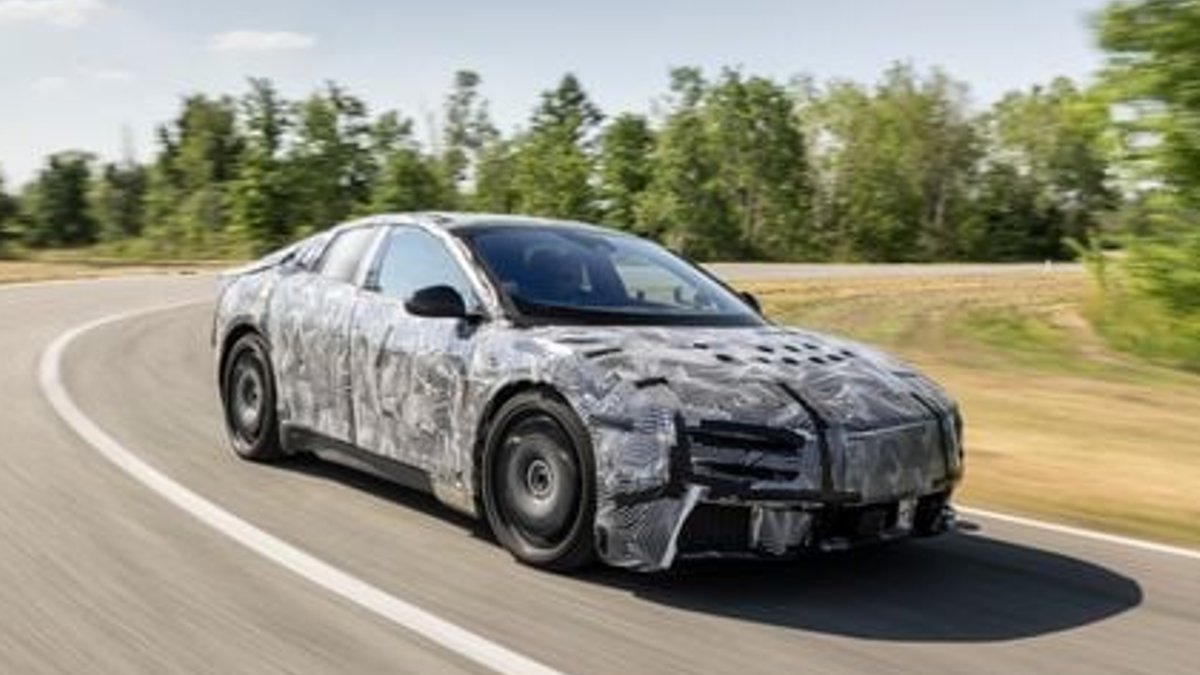
The Ferrari Luce will be the brand’s first electric vehicle. It will also be its largest and heaviest model to date. The four-door hatchback weighs 2,260 kilograms. For the first time, Ferrari outsourced exterior styling to a non-Italian design firm. The five-seat layout resembles a luxury sedan more than a traditional Ferrari.
Performance figures tell a different story. The Luce accelerates from 0 to 100 km/h in under 2.5 seconds and reaches 200 km/h in 6.8 seconds, with a top speed of 310 km/h. Those numbers surpass the Purosangue by eight-tenths of a second to 100 km/h and 3.8 seconds to 200 km/h. Ferrari compares its straight-line speed to the 849 Testarossa rather than its own SUV.
The powertrain rewrites Ferrari’s rulebook
The Luce’s electric drivetrain uses four radial-flow permanent magnet e-motors arranged in a Halbach array. This configuration, taken from Ferrari’s Formula 1 program, directs magnetic flux toward the stator to maximize torque. Front motors produce 105 kW and 140 Nm each, while rear units generate 310 kW and 355 Nm. Combined output reaches 772 kW (1,036 horsepower) and 990 Nm of torque.
Related: Holden factory becomes post parcel hub
A 122 kWh battery and 800-volt architecture power the system, managed by silicon carbide inverters. Regenerative braking can recover up to 500 kW, with lift-off regen providing 0.68 g of deceleration. Standard carbon-ceramic brakes feature 390 mm rotors up front and 372 mm at the rear, though the powertrain handles most stopping under normal conditions.
The chassis uses an aluminum-intensive skateboard design with an upgraded semi-active suspension from the F80 and Purosangue. Rear-wheel steering allows each rear wheel to turn independently by up to 2.15 degrees. Ferrari’s Side Slip Control system, SSC X, coordinates torque vectoring, regenerative braking, and suspension settings across all four wheels.
Driving impressions: A heavyweight that doesn’t feel like one
A camouflaged prototype at Stellantis’ Balocco proving ground shows the Luce defies its mass. Ferrari product development chief Gianmaria Fulgenzi stated the car would feel 200 kg lighter than its actual weight. That assertion proves accurate within minutes. Despite being the brand’s heaviest model, the Luce changes direction with unexpected agility, transitioning smoothly from hard braking to full acceleration.
Steering remains light but linear, with clear feedback through the thin-rimmed wheel. The suspension, tuned with a 20% increase in damper pitch, absorbs rough pavement better than the Purosangue while maintaining tight body control at speed.
Related: Ford Tops Latest Quality Study Rankings
Traction stands out, particularly at the rear. Four-wheel steering operates almost imperceptibly, primarily managing high-speed stability rather than tightening low-speed turns. The Luce’s composure comes from SSC X, which balances regen levels and torque distribution in real time. The transition between regenerative and mechanical braking feels mostly seamless, though hard driving makes the increase in mechanical braking force noticeable as carbon-ceramic discs heat up.
Two Manettino dials on the steering wheel control driving modes. The right-side dial selects vehicle settings—Ice, Wet, Dry, Sport, and ESC-Off—while the left-side E-Manettino adjusts powertrain behavior. Range mode limits power to 320 kW and top speed to 260 km/h, disconnecting the front motors when possible for efficiency. Tour mode raises power to 460 kW while keeping the top speed capped. Performance mode unlocks the full 725 kW and 310 km/h, with an additional 40 kW available in Launch Control.
In Sport and Performance modes, acceleration feels relentless. Power delivery remains linear, unlike most electric vehicles. Rear motors spin up to 25,500 rpm, the fronts to 30,000 rpm—far higher than typical electric motors. This gives the car a responsiveness similar to a small-displacement V12. The artificial sound, generated by the rear motors and tuned to resemble a muffled V12, provides audible feedback on traction, letting the driver hear when the rear tires begin to slip.
Ferrari development test driver Raf
Related: Methanol engine could boost electric vehicles
The prototype tested is nearly production-ready, with hardware finalized. Engineers are now fine-tuning powertrain and software calibrations. Planned adjustments include smoother acceleration from a standstill to 20 mph and softer rebound settings to reduce abruptness after aggressive cornering.
A Ferrari, just not the one we expected
The Luce debuts as Ferrari’s identity evolves. The brand spent decades refining what a Ferrari should be—lightweight, rear-wheel-drive, and distinctly Italian. The Luce breaks from all three traditions. It’s a four-door, all-wheel-drive EV styled by a foreign team, and it outweighs every previous Ferrari. Yet in its driving trends, it feels like a natural extension of the brand’s engineering approach, not a radical shift.
Ferrari chairman John Elkann described the Luce as a proactive move, not a response to market trends. “The future is not something we wait for,” he said at the car’s launch in Rome. “The future is something we create.” The powertrain, chassis, and software were all developed in-house at Maranello by the same team behind the F80 supercar.


Leave a Reply